

Environmental Signal Coupling
A hypothesis of how life is informed and curated.

An organism’s fitness is axiomatically dependent on the specific conditions of its environment. ‘Fitness’ — a measure of how likely a living system will survive and propagate — is a function of an organism’s capacity to adapt to its surroundings. This adaptive capacity is intrinsically reliant on the integration of, and response to, various types of environmental stimuli. In other words, environmental conditions define what is biologically adaptive or maladaptive. A refined capacity to transduce environmental information and subsequently generate favourable physiological, anatomical and behavioural responses is a cardinal facet of life. Simply, we are products of our environment.

Key here is the direction of informational flow. Organisms are informed by the signals present in their unique locale. We rely so heavily on the fidelity and timing of these environmental signals, that extraordinarily intricate systems evolved to sense and relay them in order to orchestrate physiological functions. Dynamic adaptation is an emergent property of clear and precise environmental signal integration under the flow of energy. This highlights a salient issue: how can we define ‘the environment’? I posit here that a particularly useful conceptualisation is the simultaneous influence of the following:1
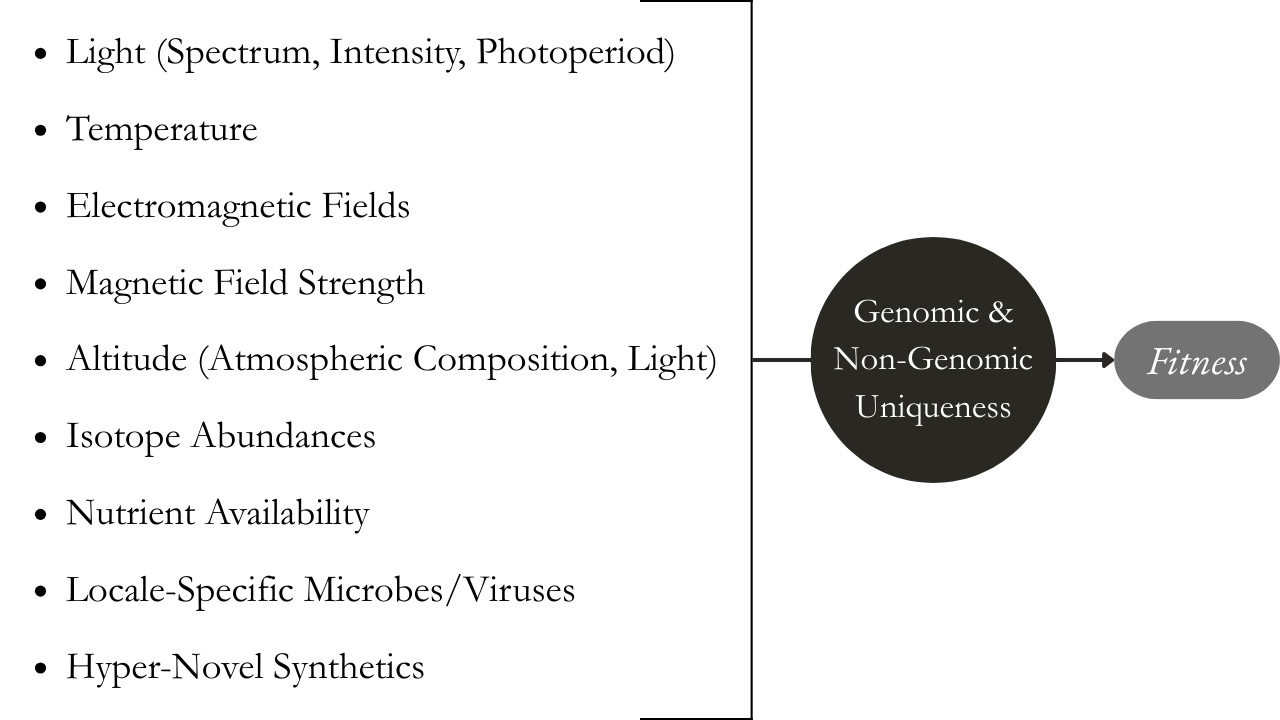
These signals couple together and integrate concurrently, acting as a kind of dynamic environmental barcode. Throughout our evolutionary history, we have developed particular sensitivities within the ranges of natural signals, with individuals from different regions developing variations in their integrating faculties.2 Anthropogenic signals played no role in the delicate curation of the systems by which we detect and integrate environmental information.3 As a result, the superimposing of hyper-novel signals on these finely-tuned systems produces states that are incongruent with our true environment.4 A simple, yet pertinent example of this is artificial light. In the modern world, we are able to provide an artificial signal of daytime out of sync with the true environment. This incongruence shapes our highly refined adaptive mechanisms, promoting maladaptive states we refer to as disease.
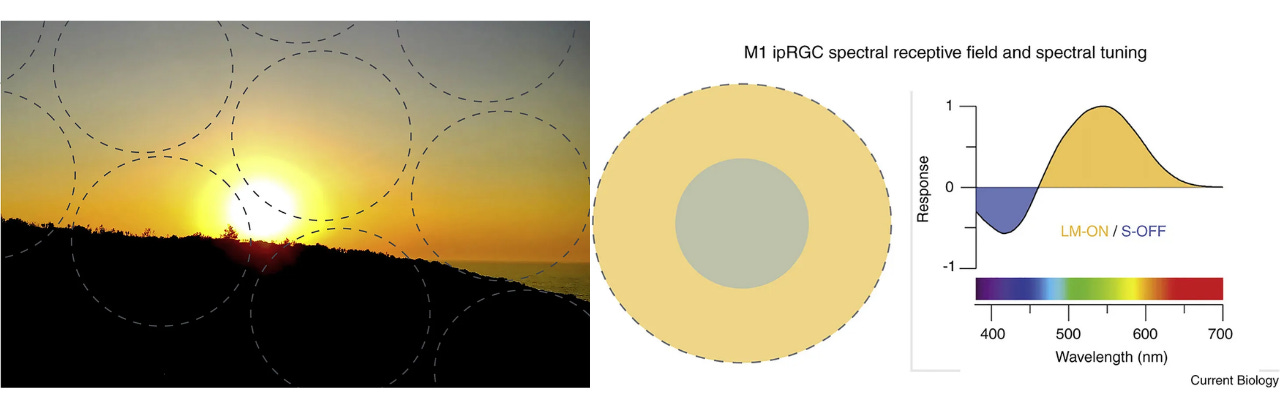
Natural signals that are constrained by the limits Earth’s niche. For example, equatorial regions are generally characterised by relatively stable photoperiods, higher photon energy and flux, low magnetic field strength, high average temperature and greater access to carbohydrates (↑2H, ↑13C). Conversely, polar regions experience significant seasonal fluctuations in photoperiod and spectral content, with relatively high magnetic field strength, low temperatures and greater reliance on provisions from higher trophic levels (↓2H, ↓13C, ↑15N). Each region on Earth has a unique set of dynamic environmental signals that, when faithfully integrated, can produce adaptive changes.5 Importantly, these signals are filtered by both the genomic and non-genomic uniqueness of each individual. This suggests that even in the presence of a true environment, if one’s unique adaptations were forged in a different environmental niche, such signals may still elicit maladaptive responses.6

Each of these signals exist in a web of interactions where the cumulative signal (what we refer to as ‘the environment’) is greater than the sum of its parts — each aspect ‘yokes’ together to produce unique physiological responses. The key implication herein is that the presence of anthropogenic signals ‘un-yokes’ the cumulative signal. Think about a native Inuit during winter, exposed to conditions of cold temperatures, strong magnetic field, short photoperiod and predominantly animal nutrition — all signals that are native, and thus, yoked. If they were to then use a UVB lamp on their bare skin or consume starch-rich corn grown in Bolivia, the signals become incongruent with their surroundings (and their finely tuned genomic and non-genomic uniqueness). While the effects of such stimuli might appear negligible, we can anticipate that the biological responses must be maladaptive in the context of their current environment.7
This hypothesis of environmental signal coupling (synsêmaperivállon) posits that incongruence between integrated and true signals produces maladaptive biological responses by definition. Such responses are maladaptive because they deviate (often by orders of magnitude or even category) from signals we have evolved expecting to receive. This detachment from evolutionarily-consistent signals promotes biological responses that are incongruent with our underlying energetic landscape. Such responses often necessitate a suite of compensatory mechanisms we collectively call, chronic disease.
This framework may be a useful tool in generating anti-reductionistic hypotheses. In complex systems, the relationships between the nodes of the system are frequently more important than the nodes themselves. Take, for example, the concept of a food pyramid (or similar construct). In a country like Australia that stretches latitudinally from 10°41' S to 43°38' S, how could identical dietary recommendations be made across such diverse environments? Accounting for the concept of environmental signal coupling, there is a recognition that nutrition-related signals shift alongside each of the other facets of ‘the environment’ — ie., the adaptive response is expected to be coupled to the entire suite of environmental signals. Strong UV light induces ROS which then behave differently in lower magnetic fields. Carbohydrates are enriched in deuterium, but strong IR light lowers interfacial water viscosity caused by solvent isotope effects. Cold temperatures occur where photoperiods are shorter, promoting thermogenesis through hormonal changes. Attempts to understand the biological impacts of each factor now incorporate the web of signals in a recognition of their coupling.
This framework allows us to posit that the diet most optimal for someone to consume is one from the same coupled signals they themselves are experiencing. For someone of European lineage living in Australia, we can hypothesise that their optimal level of sunlight exposure exists somewhere between what their genomic and non-genomic adaptations optimise for, and that which is yoked to their true environment. Similarly, we might expect fructose consumption without more equatorial light parameters, lower magnetic field strengths and higher average temperatures — consistent with natural signal coupling — might produce maladaptive responses.
This hypothesis of environmental signal coupling helps to explain why non-native exposures of any kind tend to produce ill-health. Constant temperatures, artificial light, anthropogenic electromagnetic energy, imported foods and synthetic chemicals culminate in an environmental barcode that is fundamentally incongruent with us. The most concerning, perhaps, are those signals that are categorically novel. These include anthropogenic electromagnetic energies, synthetic chemicals and to some extent, narrowband artificial light. These are signals never experienced by any organisms over 4+ billion years of evolution. It may be no wonder why they appear to be at the core of declining health.
More frequently than not, the signals that will optimise fitness are of the true environment — those present in your immediate locale.8 Signals outside of this range stand to produce potentially maladaptive responses.9 What is important to remember is that it is the environment that defines fitness. Our ability to sense and integrate the environment determines the extent of our adaptive capacity.
“Nature never stoops to a perfect correlation.”
— Nick Lane
Related Articles


Related Podcasts
It is certain that this list is lacking features, however, the approximation seems to be conceptually adequate.
Consider the emergence of light eye colour, pale skin and blonde hair in response to different environmental conditions. These adaptations fundamentally shape the way signal integration occurs. Even in the same conditions, individuals with different pigmentation experience different signals.
Fire was the closest we came to an anthropogenic signal for the majority of our evolutionary past as anatomically modern humans. Besides this, it wasn’t until the agricultural revolution where access to signals that even remotely deviated from nature began. Even here, access to starch and various other nutrients was the principal deviation. It is really in the last 150 years where exposure to anthropogenic signals has increased exponentially.
A true environment could be thought of as one’s locale-specific signals, stripped of all anthropogenic influence. Few (if any) true environments exist on Earth today. It should be noted that true environments may be maladaptive too if the genomic and non-genomic uniqueness of the individual has evolved in a vastly different environment.
It should be noted that the faithful integration of signals requires the presence of adequate resources. In order for environmental signals to promote adaptive changes, specific resources are required to facilitate these systems. For example, circadian entrainment requires vitamin A due to its role in the binding and function of opsin proteins. Signals can only be transduced where adequate resources are available.
A clear example of this phenomena would be for someone of East-African descent to move to northern Finland — their dark skin and L0 mitochondrial haplotype are fundamentally unable to faithfully integrate those specific environmental signals.
This is the normalised state of affairs in the modern world. The majority of the signals we receive are at odds with our true environment.
However, incongruent signals may also be used therapeutically where one’s genomic and non-genomic traits are unsuited for their true environment.
The degree to which this occurs may be rather minimal, of course. Eating some chocolate from Peru while in Mozambique is no disaster.
Hi, Cameron. I appreciate your attention to detail (as usual ;-) in stipulating the argument. I arrived to a very similar hypothesis, but I never found any research paper that tried to test it. As i feel that mere statisticall correlations are insufficient for supporting any hypotheis, I am curious to learn from your expierndce: are you aware of any research papers that try to stress-test the impact of anthropogenic signals on human health?